

Parking is available throughout Nairobi, but the right option depends on where you are going, how long you will stay and whether you need daytime, overnight or long-term parking.
Nairobi has:
- Nairobi City County on-street parking.
- County-managed off-street parking areas.
- Privately operated car parks.
- Underground and multi-storey parking garages.
- Mall, hotel, hospital and office parking.
- Short-term and long-term airport parking.
- Reserved, seasonal and loading-zone parking.
For most county parking areas, motorists pay digitally through NairobiPay or by dialling *647#. Enter the correct registration number and parking zone, complete the M-Pesa request and retain the confirmation messages. NairobiPay supports daily, seasonal, reserved and selected off-street parking services.
Quick answer: The standard county parking charge currently reported for a private saloon car is KSh300 per day. Nairobi County stated in July 2026 that reports of an immediate increase were false and that the existing rates remained in effect. Always confirm the amount displayed by NairobiPay before approving payment.
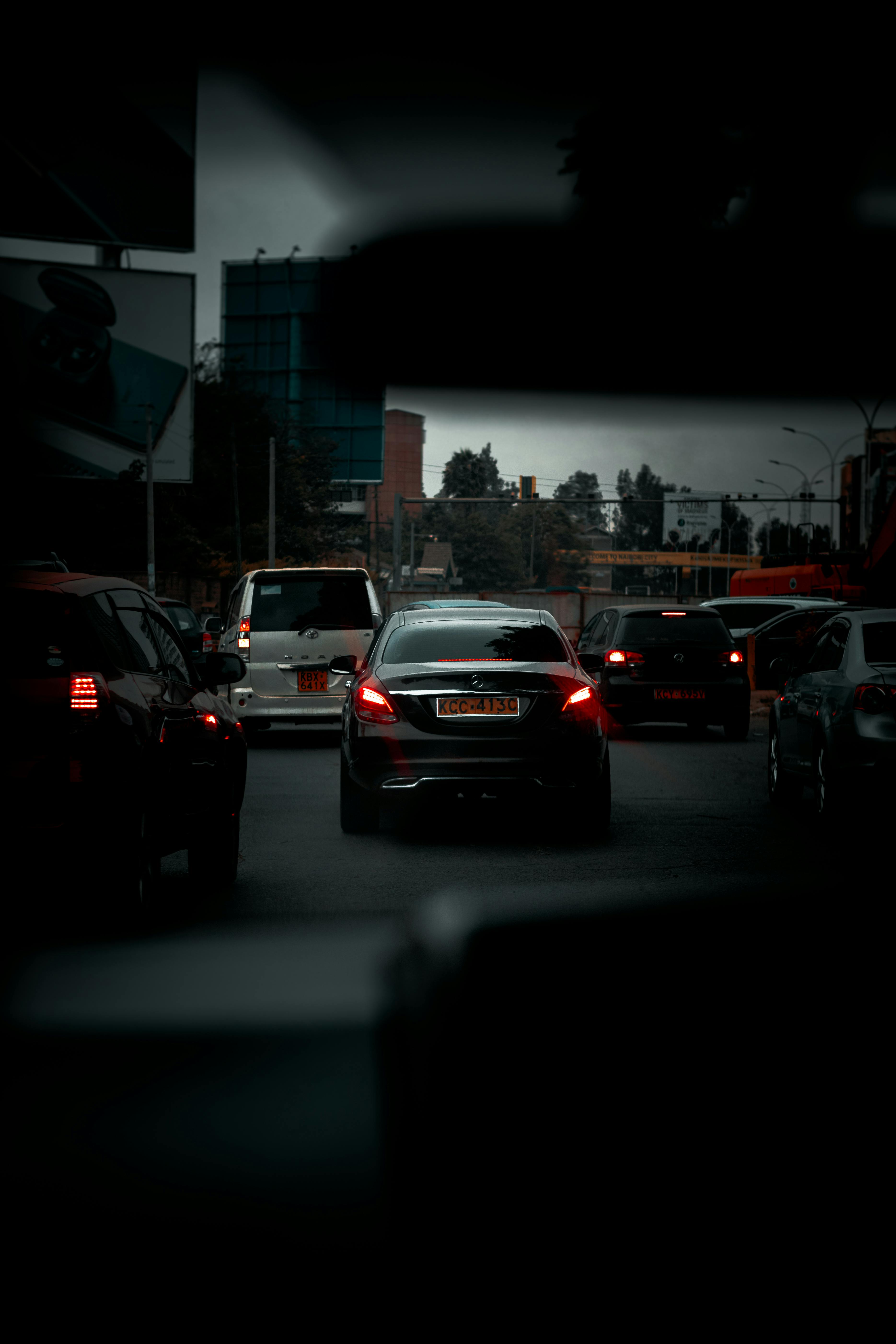
Nairobi Parking at a Glance
| Parking type | Best for | How it is charged | Main consideration |
|---|---|---|---|
| County on-street parking | Short daytime visits and CBD errands | Daily or zone-based | Select the correct zone and registration number |
| County off-street parking | Designated public car parks | Usually settled before exit | Confirm the vehicle record and checkout amount |
| Private car park | CBD visits, offices and longer stays | Hourly, daily or monthly | Security, operating hours and overnight rules |
| Mall parking | Shopping, dining and meetings | Time-based or validated | Free period, lost-ticket charge and closing time |
| Hotel parking | Guests, conferences and restaurant visits | Free, validated or chargeable | Confirm visitor access before arrival |
| Seasonal parking | Frequent commuters and businesses | Monthly or longer permit | Permit is linked to the vehicle and applicable category |
| Reserved parking | Businesses, loading and special events | Application-based | County approval does not permit unrestricted use |
| Airport parking | Flights, passenger collection and drop-off | Short-stay or long-stay | Use the correct terminal parking area |
| Attraction parking | Museums, forests, parks and wildlife centres | Free or venue-specific | Opening hours and vehicle-size restrictions |
| Residential parking | Tenants and visitors | Lease-based, private or street parking | Visitor permits and property-management rules |
How Parking Works in Nairobi
Nairobi parking is divided into two broad systems: public county parking and privately managed parking.
Nairobi City County public parking
Nairobi City County controls designated public parking spaces, including many on-street bays, market-area car parks, loading zones, seasonal permits and reserved parking applications.
County parking is generally associated with:
- Marked roadside spaces.
- County public car parks.
- Commercial centres and markets.
- Loading and unloading zones.
- Public-service vehicle parking.
- Reserved parking bays.
- Seasonal parking permits.
- Penalties, clamps, towing and impoundment.
Payments should be made through the official NairobiPay parking service or the county USSD code.
Private commercial parking
Private parking includes facilities operated by:
- Shopping malls.
- Office towers.
- Hotels.
- Churches and religious institutions.
- Hospitals.
- Residential developments.
- Universities and schools.
- Independent car-park operators.
- Tourist attractions.
Private facilities set their own tariffs, closing hours, validation rules and lost-ticket charges. Paying Nairobi County does not automatically cover a privately operated car park.
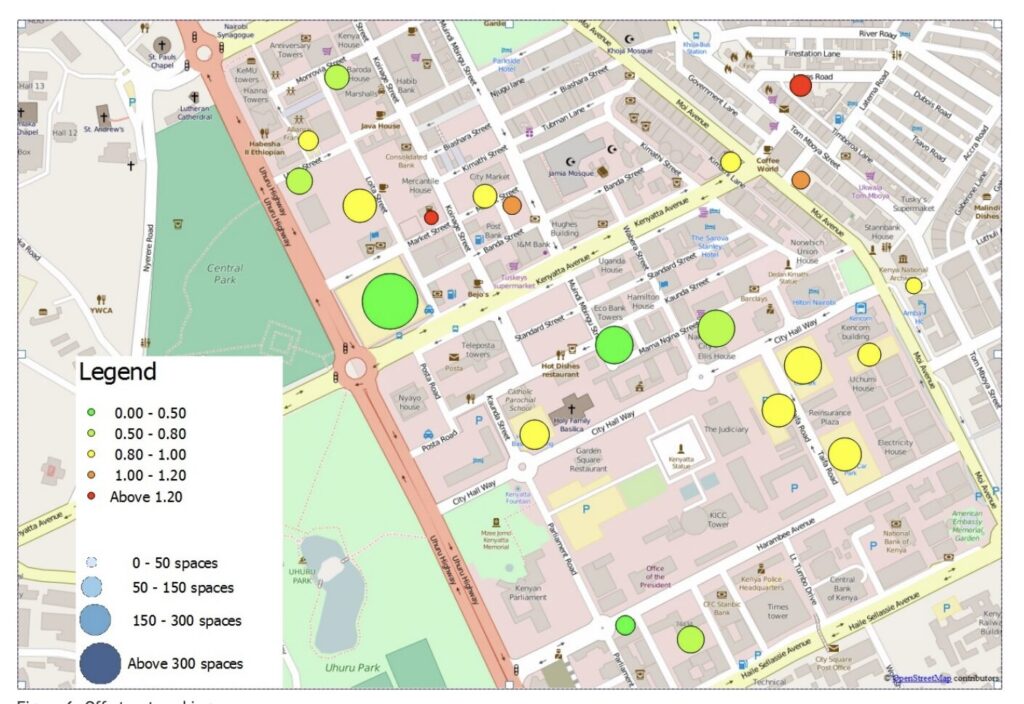
On-street and off-street parking
On-street parking consists of marked parking spaces along a public road. It is convenient for short errands but usually fills quickly in high-demand areas.
Off-street parking is separated from the main traffic lane. It may be an open lot, underground garage, podium, basement or multi-storey parking structure.
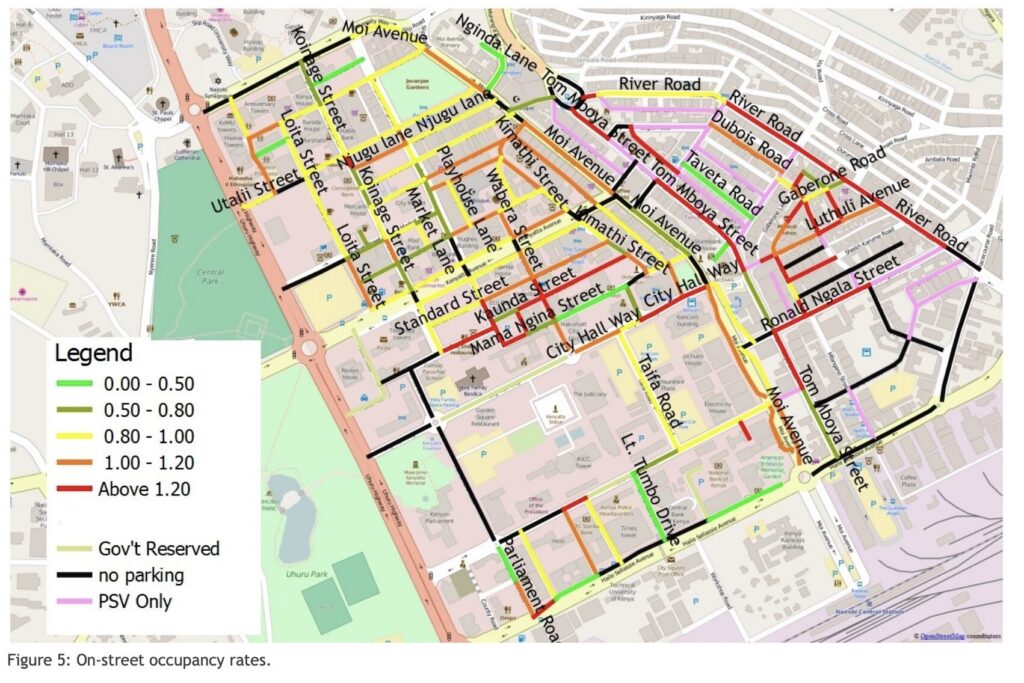
Choose off-street parking when:
- You will remain parked for several hours.
- You are visiting the CBD during peak periods.
- You need controlled entry and exit.
- You need better lighting, CCTV or guard supervision.
- You are leaving the vehicle after dark.
- You are unfamiliar with the neighbourhood.
Daily, seasonal and reserved parking
NairobiPay divides parking into several services.
Daily parking covers a single parking day in the selected zone.
Seasonal parking is intended for motorists who park regularly. The permit is purchased for a specified duration and linked to a registration number.
Reserved parking covers approved uses such as:
- Loading zones.
- Trailer parking bays.
- Public-service vehicle bays.
- Event parking-bay hire.
- Other authorised reserved spaces.
A seasonal permit does not allow a vehicle to block a driveway, park on a pavement or use a no-parking area.
Current Nairobi County Parking Fees
Standard daily and seasonal charges
Nairobi County said in July 2026 that its existing public parking charges remained in effect despite reports of a proposed increase.
| Vehicle category | Reported daily charge | Reported monthly seasonal charge |
|---|---|---|
| Private saloon car | KSh300 | KSh5,000 |
| Van or pick-up | KSh500 | KSh6,000 |
| Lorry up to five tonnes, canter or minibus | KSh1,000 | KSh12,500 |
| Heavier or specialised vehicle | Confirm through NairobiPay | Confirm through NairobiPay |
These are county public-parking rates reported following the July 2026 clarification. The payment screen remains the best source for the exact amount applicable to your vehicle and zone. (Nairobi Leo)
Has Nairobi parking increased to KSh520 or KSh535?
No immediate increase to KSh520 or KSh535 had been enacted as of 24 July 2026.
The Nairobi City County Tariffs and Pricing Policy estimates the cost of providing a parking service, but the county has clarified that the policy is a pricing framework rather than an automatic fee increase. A binding change must proceed through the applicable Finance Act and approval process.
Motorists should distinguish among:
- A policy estimate.
- A proposed tariff.
- A Finance Bill.
- An approved and assented Finance Act.
- The amount actually displayed for payment in NairobiPay.
Private car-park charges
Private parking rates are not standardised across Nairobi.
The amount may depend on:
- First-hour or grace-period rules.
- Number of hours parked.
- Daytime versus overnight use.
- Weekday versus weekend use.
- Mall, hotel or restaurant validation.
- Vehicle category.
- Event pricing.
- Monthly parking agreements.
- Lost or damaged tickets.
Check the tariff board at the entrance before accepting the ticket. Do not assume that an old online price remains current.
Mall, hospital and hotel parking
Mall parking is commonly charged by duration. Some facilities provide a short free period or validation after spending at a shop, restaurant, supermarket or cinema.
Hospitals may have:
- Emergency drop-off areas.
- Patient collection points.
- Accessible bays.
- Short-stay visitor parking.
- Overnight visitor restrictions.
Hotels may offer complimentary parking only to registered guests, conference delegates or restaurant customers. Ask whether validation is required before leaving the building.
Is Parking Free on Saturdays and Sundays?
Nairobi Governor Johnson Sakaja announced in January 2025 that county parking would be free on both Saturdays and Sundays. Public holidays have also traditionally been treated as free county-parking days.
However, Nairobi County’s older online laws page still states that parking is free only from 2:00 p.m. on Saturdays and throughout Sundays and public holidays. The two county positions are not fully aligned online.
The practical approach is:
- Treat the current announced policy as free county parking on Saturdays and Sundays.
- Check NairobiPay before leaving the vehicle.
- Follow temporary signs and enforcement notices.
- Do not assume private parking is free.
- Remember that no-parking and obstruction rules apply even when no fee is charged.
- Confirm arrangements during major events or temporary road closures.
How to Pay Nairobi Parking Through M-Pesa
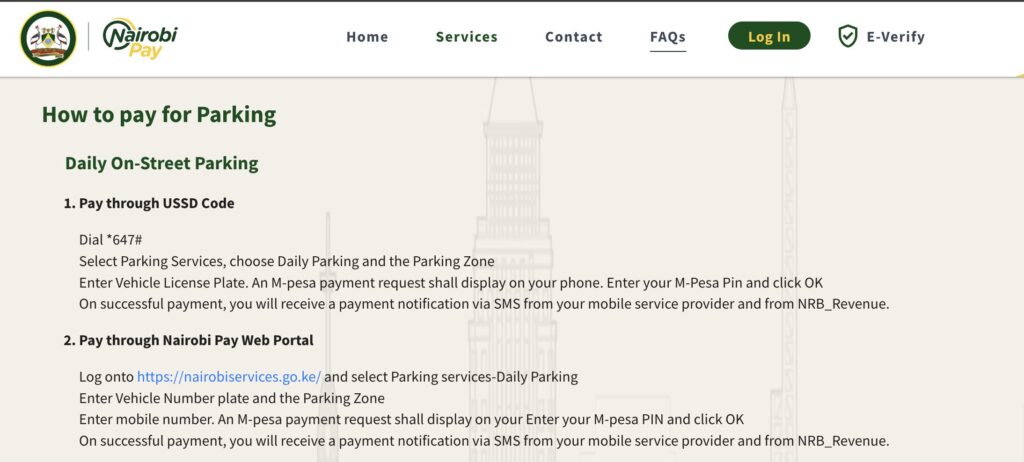
Paying by USSD
The official Nairobi County parking code is *647#.
- Dial
*647#on a mobile phone. - Select Parking Services.
- Choose Daily Parking.
- Select the correct parking zone.
- Enter the vehicle registration number.
- Review the details carefully.
- Wait for the M-Pesa payment request.
- Enter the M-Pesa PIN.
- Confirm the payment.
- Retain the M-Pesa and
NRB_Revenueconfirmation messages.
The county’s official FAQ confirms that successful payment generates messages from both the mobile service provider and Nairobi County’s revenue system.
Paying through NairobiPay
- Open the NairobiPay eServices portal.
- Select Parking Licensing Services.
- Choose Daily Parking.
- Enter the number plate.
- Select the correct parking zone.
- Enter the M-Pesa mobile number.
- Approve the payment request.
- Confirm that the transaction succeeded.
The portal also supports seasonal parking, reserved parking and transaction-history functions.
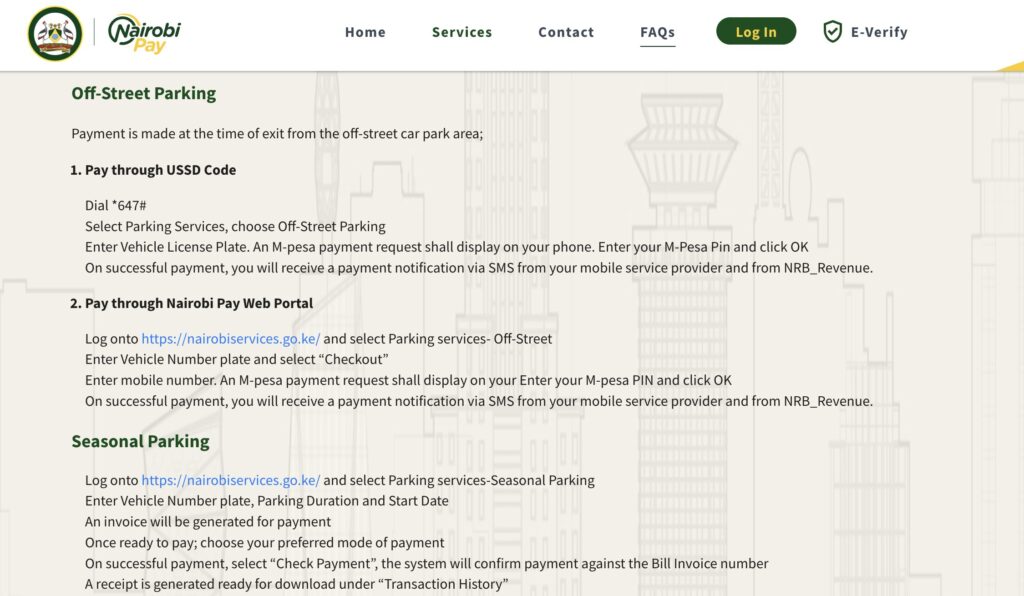
Paying for off-street county parking
For an integrated county off-street car park, payment is normally made during checkout.
- Dial
*647#and select Off-Street Parking, or use NairobiPay. - Enter the vehicle registration.
- Select checkout.
- Approve the M-Pesa request.
- Wait for confirmation before driving to the barrier.
Paying for another vehicle
You can generally pay from a different phone provided that you enter:
- The correct vehicle registration.
- The correct zone.
- The correct vehicle category where requested.
The payment is associated with the registration number, not merely the phone used.
How to enter a Kenyan number plate
Enter the registration exactly as it appears on the vehicle.
For example:
KDA 123AKDG 456BKCM 789C
Check letters that may be confused, such as:
- B and 8.
- O and 0.
- I and 1.
- S and 5.
A payment made against the wrong registration may not protect the correct vehicle from enforcement.
What if the M-Pesa request does not arrive?
Do not make repeated payments immediately.
Instead:
- Check your mobile network.
- Confirm that the phone number was entered correctly.
- Wait for a delayed prompt.
- Check your M-Pesa balance and recent transactions.
- Restart the USSD process if no debit occurred.
- Contact NairobiPay if money was deducted without confirmation.
NairobiPay lists the following support contacts:
- +254 20 724 7047
- +254 730 047 047
- nairobipay@nairobi.go.ke
Wrong registration number or parking zone
If payment was made using an incorrect registration or zone:
- Do not assume it will be transferred automatically.
- Take screenshots of the payment.
- Make the correct payment if enforcement risk is immediate.
- Contact NairobiPay with the transaction code.
- Request instructions concerning correction or refund.
- Retain all messages until the issue is resolved.
Avoid parking-payment scams
County payments should not be sent to a personal M-Pesa number.
Warning signs include:
- An attendant requesting cash without an official system record.
- A personal M-Pesa number.
- A handwritten paybill or till number.
- A website designed to resemble NairobiPay.
- Pressure to pay immediately without checking the vehicle details.
- A person claiming that
*647#is unavailable and offering another number.
Use the official NairobiPay portal and verify county officers through the county’s e-verification service where appropriate.
Nairobi Parking Zones
A parking zone connects the vehicle to the applicable location and tariff. Selecting the wrong zone may leave the vehicle recorded as unpaid where it is actually parked.
County policy documents use a zonal approach that distinguishes the busiest commercial areas from outer commercial centres.
Areas commonly treated as high-demand central locations include:
- Nairobi CBD.
- Westlands.
- Upper Hill.
- Community.
- Ngara.
- Highridge and Parklands.
- Industrial Area.
- Gigiri.
- Kilimani.
- Yaya and Hurlingham.
- Lavington.
- Karen.
- Eastleigh.
- Muthaiga.
- South B, South C and Nairobi West.
Outer commercial centres and county markets not included in the central grouping may appear under other zones. Zone names and boundaries can be updated, so select the location shown in NairobiPay rather than relying on an old list.
How to identify a legal parking space
A legal space will normally be:
- Marked with parking-bay lines.
- Positioned away from junctions and pedestrian crossings.
- Outside a bus stop, taxi rank or matatu terminus.
- Outside a loading zone unless authorised.
- Clear of gates and driveways.
- Clear of emergency and fire access.
- Consistent with nearby signs and road markings.
- Large enough for the vehicle to remain within the bay.
Do not rely solely on the presence of other parked cars. A row of illegally parked vehicles does not make the location legal.
Best Places to Park in Nairobi CBD
Parking in the Nairobi Central Business District includes county street bays, public open-air lots, church-operated parking, private garages and parking attached to commercial buildings.
On-street CBD parking
On-street parking works best for:
- Short daytime errands.
- Bank or government-office visits.
- Shopping where a bay is close to the destination.
- Early-morning appointments.
- Weekend visits when demand is lower.
Spaces around Kenyatta Avenue, Mama Ngina Street, City Hall Way, Wabera Street, Muindi Mbingu Street, University Way, Koinange Street and neighbouring roads are subject to signs, security closures and availability.
Pay immediately after parking. Do not wait for an attendant to approach.
Holy Family Basilica parking
The Holy Family Basilica complex has a modern underground parking silo close to:
- City Hall.
- KICC.
- Parliament Road.
- Harambee Avenue.
- Kenyatta Avenue.
- Government offices.
- Central CBD hotels.
The facility was designed with four basement levels and capacity for more than 500 vehicles. Operating hours and tariffs should be confirmed at the entrance because private-car-park conditions can change.
Parking near KICC, City Hall and Parliament
For appointments near KICC, City Hall or Parliament:
- Arrive early on weekdays.
- Expect road closures during state, diplomatic or political events.
- Do not park beside security barriers.
- Consider Holy Family Basilica or another controlled CBD car park.
- Keep sufficient walking time between the car park and security entrance.
- Avoid leaving the vehicle in an isolated bay after dark.
The County Assembly states that public parking stations and street parking are available around its CBD precinct.
Visitors exploring this area on foot can also use the Nairobi City Walking Tour guide to understand the KICC, City Hall, Parliament and historic CBD cluster.
Parking near River Road and downtown Nairobi
The River Road, Accra Road, Tom Mboya Street and lower-CBD area is busy with:
- Matatus.
- Delivery vehicles.
- Wholesale businesses.
- Pedestrians.
- Handcarts.
- Long-distance transport offices.
A controlled off-street car park is generally preferable to an isolated roadside bay, particularly when carrying luggage or shopping stock.
Avoid:
- Blocking shop entrances.
- Parking in a matatu stage.
- Leaving valuables visible.
- Entrusting keys to an unofficial attendant.
- Leaving a vehicle overnight without confirming security and operating hours.
Overnight parking in the CBD
Do not assume that a daytime garage allows overnight parking.
Before leaving a car overnight, confirm:
- Whether overnight parking is permitted.
- The closing and reopening time.
- The overnight or maximum daily tariff.
- Whether the vehicle can be removed after hours.
- Whether attendants remain on site.
- Whether entry and exit are controlled.
- Whether the facility accepts high-roof or oversized vehicles.
For hotel guests, hotel parking is usually safer and more practical than public street parking.
Weekend CBD parking
The CBD is usually easier to park in on weekends because commuter demand is lower. However, churches, markets, restaurants, political gatherings, public events and road closures can concentrate demand in specific streets.
Even where county parking is free, private car parks may continue charging.
Parking by Nairobi Neighbourhood
For a broader introduction to the city’s districts, see the Nairobi neighbourhoods and suburbs guide.
| Area | Typical parking | Peak demand | Best approach |
|---|---|---|---|
| CBD | Street bays, open lots, underground garages | Weekday working hours | Arrive early or use a controlled garage |
| Westlands | Malls, hotels, office basements, private lots | Workdays and evenings | Park at the destination rather than on a side street |
| Kilimani and Hurlingham | Malls, apartment bays, restaurant parking | Evenings and weekends | Confirm visitor parking before arrival |
| Upper Hill | Office, hospital and hotel parking | Weekday mornings | Pre-arrange access for office appointments |
| Gigiri and Runda | Mall, UN, embassy and private-compound parking | Weekday diplomatic hours | Carry identification and expect security checks |
| Parklands and Ngara | Hospitals, religious institutions and street bays | Working days and worship times | Use attended facilities near the destination |
| Eastleigh | Commercial lots and building parking | Shopping and wholesale hours | Avoid blocking loading zones |
| Industrial Area | Warehouse yards and commercial parking | Weekday logistics periods | Obtain site-specific access instructions |
| Karen and Lang’ata | Attraction, mall and private-compound parking | Weekends and events | Park inside the venue where possible |
| Lavington and Kileleshwa | Malls, restaurants and residential visitor bays | Evenings and school hours | Avoid unmarked residential entrances |
| South B and South C | Apartments, hotels and commercial centres | Morning and evening commute | Confirm visitor or hotel parking |
| Embakasi and Mombasa Road | Hotels, industrial sites and airport-related parking | Flight and commuter peaks | Allow extra time for service-lane access |
| Thika Road and Roysambu | Mall, university and mixed-use parking | Evenings and weekends | Use destination car parks rather than highway shoulders |
Westlands
Westlands has some of Nairobi’s most developed private parking infrastructure because of its office towers, hotels, malls, restaurants and nightlife venues.
Practical options include:
- Mall basement or podium parking.
- Hotel guest and conference parking.
- Office-building visitor parking.
- Private commercial lots.
- Limited county street parking.
Woodvale Grove and the surrounding nightlife area become busy in the evening. A mall, hotel or restaurant car park is preferable to a quiet side street after dark.
Kilimani, Hurlingham and Yaya
Kilimani combines apartment buildings, restaurants, clinics, offices and entertainment venues.
Parking problems often result from:
- Apartment visitors using public roads.
- Restaurants with limited internal space.
- School pick-up traffic.
- Vehicles blocking residential gates.
- Evening demand around entertainment venues.
Confirm parking with the business before leaving home. A restaurant listed as having parking may have only a few bays.
Upper Hill
Upper Hill is primarily an office, hospital, diplomatic and hotel district.
Weekday parking demand is highest between morning arrival and late afternoon. Office towers may require:
- Visitor pre-registration.
- Identification.
- Vehicle inspection.
- Parking validation.
- Host approval.
Do not plan to find unrestricted roadside parking beside a major government or institutional building.
Gigiri and Runda
Gigiri includes the United Nations complex, embassies, diplomatic residences, Village Market and major offices.
Expect:
- Security checkpoints.
- Restricted kerbs.
- No-stopping areas.
- Vehicle inspections.
- Identification requirements.
- Limited public access to institutional car parks.
For UN or embassy appointments, follow the parking instructions in the appointment notice. Ride-hailing may be easier when visitor parking has not been confirmed.
Parklands and Ngara
Parking demand is driven by hospitals, universities, schools, temples, mosques, churches and commercial centres.
Hospital visitors should use official visitor parking where possible. Ngara roads can be congested by matatus, buses and pedestrians, so avoid informal spaces near junctions or stages.
Eastleigh
Eastleigh is a major regional trading and wholesale centre. Street space is heavily contested by:
- Shoppers.
- Deliveries.
- Wholesale loading.
- Matatus.
- Handcarts.
- Commercial vehicles.
Use a secure commercial car park or building parking whenever available. A legal-looking gap may be an active loading or delivery zone.
Industrial Area
Industrial Area parking is oriented toward employees, warehouses, trucks and delivery vehicles.
Visitors should obtain:
- The correct gate.
- Loading or delivery instructions.
- Vehicle-size restrictions.
- Driver waiting arrangements.
- Overnight-security confirmation.
Do not park a truck or trailer in an ordinary saloon-car bay.
Karen and Lang’ata
Karen and Lang’ata destinations commonly have parking within their own compounds.
These include:
- Shopping centres.
- Restaurants.
- Hotels.
- Museums.
- Wildlife attractions.
- Schools.
- Event venues.
- Nairobi National Park facilities.
Traffic builds along Lang’ata Road, Magadi Road and Karen Road during school, commuter and weekend periods. See the Nairobi streets and roads guide when planning the approach.
Lavington and Kileleshwa
Parking is usually attached to malls, apartment developments, offices and restaurants.
Avoid parking:
- Across an apartment entrance.
- On a narrow corner.
- Beside a school gate during collection time.
- On a pavement.
- Where residential signs prohibit visitors.
South B, South C and Mombasa Road
This corridor serves:
- Offices.
- Hotels.
- Apartments.
- Industrial premises.
- Capital Centre.
- Wilson Airport connections.
- JKIA and SGR routes.
Use hotel or destination parking rather than a service lane. Mombasa Road traffic can make a seemingly close car park impractical if it requires a difficult turn or U-turn.
Donholm, Buruburu, Umoja and Eastlands estates
Parking is a mixture of:
- Estate access roads.
- Shopping-centre car parks.
- Supermarket parking.
- Apartment parking.
- Informal roadside parking.
Do not block estate access, garbage-collection points or emergency routes.
Kasarani, Roysambu and Thika Road
Major malls and mixed-use developments provide the most predictable parking.
Avoid parking on:
- Thika Road shoulders.
- Expressway approaches.
- Slip roads.
- Matatu stages.
- Pedestrian access areas.
Parking Near Nairobi Transport Hubs
JKIA parking
Jomo Kenyatta International Airport has parking for short visits, passenger collection, drop-off and longer stays.
Use:
- Short-stay parking for meeting an arriving passenger.
- Terminal parking for brief airport business.
- Long-stay parking when leaving a vehicle during a trip.
- Official pick-up and drop-off areas for ride-hailing and transfers.
The airport uses controlled access, ticketing and security screening. Tariffs and zone layouts can change, so read the signs at the entrance and payment machine.
JKIA parking tips:
- Note the terminal before driving to the airport.
- Allow time for security screening.
- Keep the parking ticket secure.
- Photograph the row or bay.
- Pay before approaching the exit if instructed.
- Confirm the long-stay rate before leaving the vehicle.
- Do not wait on airport approach roads.
- Use an airport transfer when parking for several days is uneconomical.
For broader airport and traffic planning, read Getting Around Nairobi City.
Wilson Airport parking
Wilson Airport serves domestic, regional and safari flights.
Parking capacity is more constrained than at a large international terminal. Passengers should:
- Follow airline instructions.
- Arrive with sufficient time for vehicle screening.
- Use marked visitor areas.
- Avoid leaving a vehicle for several days without airport confirmation.
- Consider hotel transport or ride-hailing for early safari departures.
Nairobi Terminus SGR parking
Nairobi Terminus at Syokimau has passenger drop-off, collection and parking arrangements around the station complex.
During busy travel dates:
- Arrive early.
- Expect queues at the access road.
- Confirm whether you are using short-stay or longer parking.
- Do not leave a passenger on the main access road.
- Record the parking area before entering the terminal.
Nairobi Central Railway Station
The Central Railway Station is in a busy section of the CBD near matatu routes and Railway City development works.
Where possible:
- Use a controlled car park.
- Avoid leaving luggage visible.
- Allow time to walk from the car park.
- Check for temporary construction or security restrictions.
- Consider ride-hailing when carrying luggage.
Bus and coach stations
Most Nairobi bus and coach stations have highly specific vehicle-access arrangements.
Private cars should not park in:
- Matatu termini.
- Bus staging areas.
- Coach loading lanes.
- Passenger-queuing areas.
- Emergency lanes.
Use a nearby public car park or arrange a brief legal drop-off.
Parking Near Nairobi Attractions
For itinerary planning, see the top attractions to visit in Nairobi.
| Attraction | Parking situation | Practical advice |
|---|---|---|
| Nairobi National Park | Parking and vehicle access at designated gates | Use the gate matching your planned route |
| Nairobi Safari Walk | Visitor parking near the KWS entrance area | Arrive early on weekends and school holidays |
| Giraffe Centre | Visitor parking at or near the facility | Capacity can tighten during peak visiting hours |
| Sheldrick Wildlife Trust | Controlled visitor-arrival arrangements | Follow booking and arrival instructions |
| Karen Blixen Museum | On-site visitor parking | Suitable for normal cars and tour vehicles |
| Nairobi National Museum | Visitor parking within the museum complex | Allow extra time during events |
| KICC | Nearby public, private and underground CBD parking | Walk from a secure car park |
| Karura Forest | Parking at public gates | Select the gate before travelling |
| Nairobi Arboretum | Parking at the main entrance | Small car park; arrive early during events |
| Bomas of Kenya | On-site parking | Suitable for groups and tour vehicles |
| Uhuru Gardens | Venue parking subject to access and events | Check temporary security arrangements |
Nairobi National Park
Drivers can enter Nairobi National Park through designated gates. The most commonly used approach is the main KWS gate along Lang’ata Road, while other gates may be more convenient for Mombasa Road or airport-side itineraries.
KWS states that the park opens at 6:00 a.m. and closes at 6:00 p.m. for day visitors. General road rules apply inside the park, and visitors should remain in vehicles except at designated locations.
Before self-driving, review the Nairobi National Park guide.
Important parking and vehicle points:
- Pay park entry through the authorised KWS system.
- Do not leave the car in an undesignated wildlife area.
- Keep doors closed inside the park.
- Do not block another safari vehicle.
- Use designated picnic and visitor areas when leaving the vehicle.
- A low-clearance saloon car may be unsuitable after heavy rain.
- Pop-up-roof safari vehicles may exceed normal garage-height limits elsewhere in the city.
Nairobi Safari Walk and Animal Orphanage
These KWS attractions are reached from the Lang’ata Road side of the Nairobi National Park complex.
Use the designated visitor parking and avoid leaving the car on Lang’ata Road. Weekends, public holidays and school trips increase demand.
Giraffe Centre
The Giraffe Centre has visitor-parking arrangements near its entrance. Because the attraction is popular and visits are relatively concentrated, the parking area can fill during peak periods.
Arrive earlier when:
- Visiting on a weekend.
- Combining it with Sheldrick Wildlife Trust.
- Travelling with a school or tour group.
- Using a bus or large safari vehicle.
Sheldrick Wildlife Trust
Visitor access is booking-controlled. Follow the instructions supplied with the reservation regarding arrival, parking and entry.
Do not assume that waiting or parking outside the designated visitor area is permitted.
Karen Blixen Museum
The museum compound has visitor parking and is generally suitable for cars, vans and tour vehicles. On event days, staff directions supersede normal parking arrangements.
Nairobi National Museum
The museum complex has visitor parking, but capacity can be affected by exhibitions, conferences, school visits and weekend demand.
Park within the controlled compound rather than on a quiet section of Museum Hill.
KICC
KICC is surrounded by government, convention and CBD traffic. Parking availability can change during conferences and official events.
Good options include:
- Underground private parking near City Hall.
- A recognised CBD garage.
- Hotel parking where you are a guest or customer.
- County street parking where legal and available.
Allow time for security screening and walking.
Karura Forest
Friends of Karura states that parking is available at the principal public gates. Gate choice matters because the main forest and Sigiria sections have different access points. Payments are handled through the applicable gate and eCitizen process.
Common access points include:
- Gate A off Limuru Road.
- Gate C, commonly called Sharks Gate, off Kiambu Road.
- The Sigiria entrance at the end of Thigiri Lane.
Choose the gate based on your intended walking, cycling or dog-walking route.
Nairobi Arboretum
The main entrance has a car park. The Arboretum currently lists separate parking charges by vehicle type, including cars, minivans and buses. See the Nairobi Arboretum guide for current access and parking details.
Bomas of Kenya
Bomas of Kenya has on-site parking suitable for visitors, private tour vehicles and groups. Event days may involve directed parking or separate bus arrangements.
Parking at Malls
Nairobi malls generally provide the easiest parking for visitors because they combine:
- Controlled entry.
- Security screening.
- CCTV.
- Guards.
- Basement, rooftop or open-air bays.
- Marked accessible spaces.
- Direct access to shops and restaurants.
Major examples include:
- Sarit Centre.
- Westgate.
- The Mall Westlands.
- Village Market.
- Two Rivers.
- Yaya Centre.
- Junction Mall.
- Lavington Mall.
- The Hub Karen.
- Galleria.
- Garden City.
- Thika Road Mall.
- Capital Centre.
- Prestige Plaza.
Before leaving the vehicle, check:
- Free or grace period.
- Hourly tariff.
- Maximum daily charge.
- Overnight policy.
- Lost-ticket charge.
- Payment method.
- Closing time.
- Validation rules.
- EV charging restrictions.
Parking validation
Some restaurants, supermarkets, cinemas, clinics or offices validate part of a parking charge.
Ask before paying. Validation may require:
- A receipt.
- A stamped ticket.
- A QR code.
- A minimum purchase.
- Payment at a specific desk.
Lost parking tickets
A lost ticket may trigger:
- Identity verification.
- Vehicle-ownership checks.
- CCTV review.
- A fixed lost-ticket fee.
- Payment of the maximum daily tariff.
- Delayed exit.
Keep the ticket with you rather than leaving it inside the vehicle.
Hotel, Restaurant and Nightlife Parking
Hotel parking
Ask the hotel whether parking is:
- Included for overnight guests.
- Available to restaurant customers.
- Available to conference delegates.
- Subject to registration at reception.
- Suitable for high-roof safari vehicles.
- Accessible throughout the night.
Restaurant parking
Many stand-alone restaurants have limited compounds. During busy evenings, attendants may use stacked or tandem parking.
Before handing over a key:
- Confirm that the attendant works for the establishment.
- Remove valuables.
- Check whether the vehicle may be moved.
- Photograph the condition of the vehicle.
- Retrieve the key directly from authorised staff.
Nightlife parking
For evening visits in Westlands, Kilimani or the CBD:
- Prefer a controlled garage, hotel or mall.
- Do not leave laptops or bags visible.
- Avoid isolated residential streets.
- Confirm that the facility remains open until departure.
- Use ride-hailing when secure parking is uncertain.
- Never drive after consuming alcohol.
Hospital Parking
Hospitals such as Kenyatta National Hospital, Nairobi Hospital, Aga Khan University Hospital, MP Shah Hospital, Mater Hospital and specialist centres have their own access and parking systems.
Hospital drivers should distinguish among:
- Emergency entrance.
- Ambulance access.
- Patient drop-off.
- Outpatient visitor parking.
- Inpatient visitor parking.
- Staff parking.
- Accessible parking.
- Funeral or mortuary access.
Do not leave a car in an emergency drop-off bay after the passenger has entered the hospital.
During an emergency:
- Follow security instructions.
- Drop the patient at the correct entrance.
- Move the vehicle to visitor parking.
- Keep the parking ticket and hospital details together.
- Ask about overnight access if admission is required.
Nairobi Parking Rules
Nairobi County identifies several parking offences, including parking without payment, parking on a pavement, unauthorised reservation of a public space, commercial use of a bay and damaging or attempting to remove a clamp.
Park only in designated areas
A vehicle should remain wholly within a marked bay.
Do not park:
- On a pavement.
- In a county garden or green space.
- Across a driveway.
- On a pedestrian crossing.
- Beside a no-parking sign.
- In a fire lane.
- In an emergency-access route.
- In a disabled bay without authorisation.
- At a bus stop.
- In a matatu terminus.
- In a taxi rank.
- In a loading zone without authority.
- In a lane that obstructs traffic.
- On a road shoulder where stopping is prohibited.
Double parking
Double parking reduces the usable road width and may trap legally parked cars.
It is particularly disruptive in:
- Eastleigh.
- The CBD.
- Ngara.
- Market streets.
- School zones.
- Hospital entrances.
- Industrial loading areas.
An attendant’s assurance does not make double parking lawful.
Parking on pavements
Parking or driving on a pavement endangers pedestrians and can result in enforcement. Leave the full pedestrian route clear.
Loading and unloading zones
Loading bays are intended for active loading or unloading, not ordinary long-stay parking.
Businesses requiring a regular loading bay should apply for the relevant county reservation rather than placing cones, signs or objects in a public space.
Reserving a public parking bay
A person or business should not reserve a county bay using:
- Cones.
- Chairs.
- Stones.
- Chains.
- Signboards.
- Attendants.
- Unauthorised road markings.
Official reserved bays require county approval.
Repairing or washing vehicles
Public parking spaces are not ordinary workshops or car-wash bays.
Avoid:
- Mechanical repairs except in an emergency.
- Dismantling a vehicle.
- Washing a vehicle on the road reserve.
- Selling goods from the vehicle.
- Using the bay as a permanent advertising position.
What Happens When a Vehicle Is Clamped?
A vehicle may be clamped because of:
- Unpaid parking.
- Payment against the wrong registration.
- Payment for the wrong zone.
- Parking in a prohibited location.
- Obstruction.
- Use of a restricted or reserved bay.
- An invalid or expired permit.
- Outstanding parking penalties.
What to do immediately
- Do not drive or attempt to move the vehicle.
- Do not damage or remove the clamp.
- Photograph the vehicle, clamp, parking bay and notice.
- Read the Parking Charge Notice.
- Confirm that the notice corresponds to your registration.
- Follow the official payment instructions.
- Keep the transaction confirmation.
- Call the number listed for the enforcement zone if release is delayed.
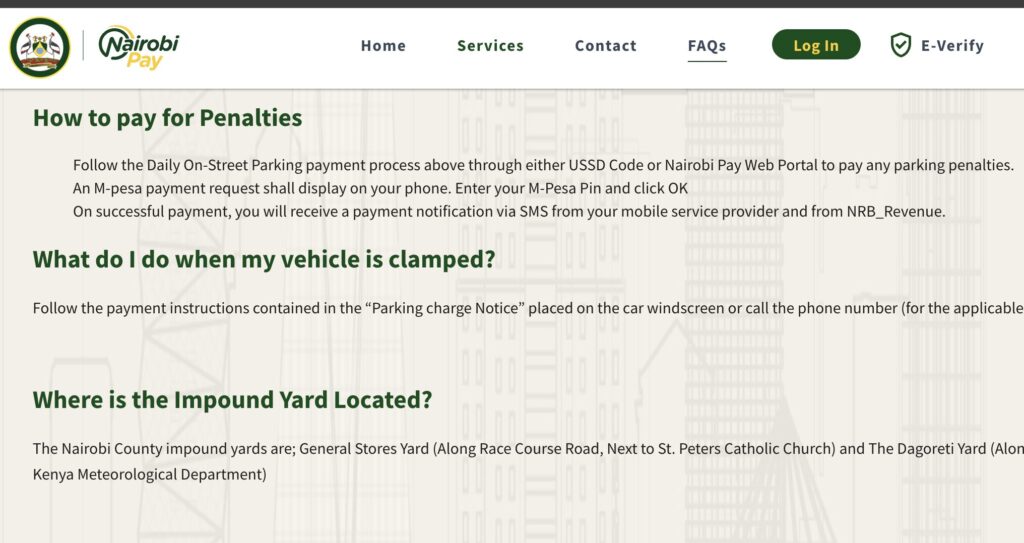
NairobiPay instructs clamped motorists to follow the notice placed on the windscreen or call the applicable zone contact. (Nairobi Pay)
Do not pay an individual officer
Pay through the official county channel. Request clarification if anyone asks for cash or a transfer to a personal number.
Challenging an incorrect clamp
Gather:
- NairobiPay receipt.
- M-Pesa confirmation.
- Vehicle registration.
- Photograph of the bay.
- Photograph of relevant signs.
- Photograph of the notice.
- Time and location.
- Any communication with the county.
Contact NairobiPay or the county parking desk. Nairobi County also lists parking-complaint support through its service and help-desk pages.
What Happens When a Vehicle Is Towed?
A vehicle may be towed when it:
- Has not been released after clamping.
- Obstructs traffic or access.
- Is parked in a prohibited area.
- Appears abandoned.
- Creates a safety or security risk.
- Is subject to enforcement action.
NairobiPay identifies two county impound yards:
- General Stores Yard: Race Course Road, next to St Peter’s Catholic Church.
- Dagoretti Yard: Ngong Road, near the Kenya Meteorological Department.
Before collecting a vehicle, confirm what documents are required. These may include:
- National identification or passport.
- Driving licence.
- Vehicle logbook or proof of ownership.
- Authority letter for a company vehicle.
- Parking and penalty receipts.
- Towing and storage-payment confirmation.
Nairobi County warns that unpaid towing fees and related expenses may eventually lead to disposal procedures after the applicable notice period.
How to Park Safely in Nairobi
Choose a secure facility
A safer car park generally has:
- Controlled entry and exit.
- Visible security personnel.
- Adequate lighting.
- CCTV.
- A ticket or digital vehicle record.
- Clearly marked bays.
- Predictable opening hours.
- Pedestrian access to the destination.
- A formal complaints process.
Remove valuables
Do not leave the following visible:
- Laptop bags.
- Cameras.
- Phones.
- Passports.
- Shopping bags.
- Cash.
- Vehicle documents.
- Safari equipment.
- Luggage.
- House keys.
A covered bag still signals that something may be inside.
Protect vehicle accessories
Where possible:
- Fold mirrors in.
- Lock doors and windows.
- Activate the alarm.
- Use an immobiliser or tracker.
- Avoid leaving a spare key in the car.
- Park in a well-lit area.
- Record existing vehicle damage.
Verify attendants
An official or facility attendant should be identifiable.
Be cautious when a person:
- Appears only after you park.
- Demands cash.
- Requests the car key without a ticket.
- Offers an unofficial “reserved” bay.
- Claims the official payment system is unavailable.
- Pressures you to leave immediately.
Photograph the parking location
A quick photograph can record:
- The bay.
- Nearby signs.
- Vehicle position.
- Surrounding landmarks.
- Ticket number.
- Parking level and row.
This helps with locating the car and resolving disputes.
Night parking
At night, prefer:
- Hotel parking.
- Mall or mixed-use parking that remains open.
- Controlled private garages.
- Attended event parking.
- A secure residential compound.
Avoid quiet roadside parking where there is little lighting or pedestrian activity.
What to do after theft or damage
- Do not alter the scene unnecessarily.
- Notify facility security.
- Photograph the damage.
- Request the incident book.
- Ask the facility to preserve CCTV.
- Report theft or serious damage to the police.
- Notify the insurer promptly.
- Retain tickets, receipts and witness details.
A disclaimer stating that vehicles are parked at the owner’s risk does not prevent you from documenting and reporting an incident.
Accessible Parking
Accessible bays are intended for motorists and passengers with mobility needs.
A suitable accessible space should provide:
- Extra side clearance.
- A level surface.
- Proximity to an entrance.
- Kerb-ramp access.
- A safe pedestrian route.
- Lift access where parking is underground.
- Space for wheelchair transfer.
Do not use a disabled bay merely because other spaces are occupied.
Visitors with limited mobility should contact the destination in advance to confirm:
- Whether accessible bays exist.
- Whether a lift is working.
- Whether assistance is available.
- The most accessible entrance.
- Whether the route from parking has steps.
Parking for Safari Vehicles and High-Roof Vans
Safari vehicles may have:
- Pop-up roofs.
- Roof racks.
- Spare wheels.
- Raised suspension.
- Rear ladders.
- External awnings.
- Greater length or width.
Before entering an underground garage:
- Check the posted height.
- Keep the pop-up roof fully closed.
- Account for roof racks and equipment.
- Confirm turning clearance.
- Avoid ramps with low overhangs.
- Ask the attendant when uncertain.
An open-air car park may be more appropriate for a modified Land Cruiser, safari van or tourist bus.
Motorcycle and Bicycle Parking
Motorcycles should use designated bays or authorised boda-boda operating areas.
Do not leave a motorcycle:
- On a pavement.
- Across a building entrance.
- In an accessible bay.
- In a pedestrian route.
- Inside a matatu space.
- Against emergency equipment.
The county has been developing designated operating zones, pick-up points and registration requirements for boda-boda services.
Cyclists should use a bicycle rack where available and secure both the frame and wheels.
Electric-Vehicle Parking and Charging
EV charging is available at selected malls, hotels, offices and private facilities, but coverage is not yet universal.
Before relying on a charging point, confirm:
- Connector type.
- Charging speed.
- Operating status.
- Access hours.
- Parking tariff.
- Charging tariff.
- Whether advance booking is required.
- Whether the bay has a time limit.
An EV charging bay should not be used as ordinary parking by a vehicle that is not charging.
Parking for Buses, Trucks and Trailers
Large vehicles need designated facilities because they require:
- Greater turning radius.
- Larger bays.
- Weight-bearing surfaces.
- Loading space.
- Safe pedestrian separation.
- Overnight security.
- Driver waiting facilities.
A bus, lorry or trailer should not use several saloon-car spaces unless expressly directed by the operator.
Tour operators should confirm coach parking before arriving at:
- Museums.
- Hotels.
- KICC.
- Bomas of Kenya.
- Giraffe Centre.
- Karura Forest.
- Major malls.
- School or university campuses.
Seasonal, Monthly and Business Parking
Who should buy seasonal parking?
Seasonal parking may suit:
- CBD employees.
- Business owners.
- Sales representatives.
- Fleet operators.
- Delivery businesses.
- Frequent county-parking users.
- Organisations with regularly used vehicles.
Compare the monthly fee with the number of working days parked.
For a saloon car:
- Daily rate: KSh300.
- Twenty weekdays: approximately KSh6,000.
- Reported monthly seasonal rate: KSh5,000.
A seasonal ticket may therefore be economical for a motorist parking most working days, subject to permit terms and space availability.
How to purchase seasonal parking
- Open NairobiPay.
- Select Seasonal Parking.
- Enter the registration number.
- Choose the parking duration.
- Select the start date.
- Generate the invoice.
- Pay using the available method.
- Select Check Payment.
- Download the receipt from transaction history.
See more on Nairobi Pay
Monthly private parking
Private monthly parking may be preferable when you need:
- A guaranteed building-specific bay.
- Overnight access.
- Covered parking.
- Security.
- Staff access.
- A reserved space near an office.
- Parking outside county-zone limitations.
Ask whether the agreement includes:
- A specific bay.
- 24-hour access.
- Replacement access cards.
- Guest parking.
- Overnight use.
- Vehicle substitutions.
- Notice periods.
- VAT.
- Liability and security conditions.
Office visitor parking
For meetings in Upper Hill, Westlands, Gigiri or the CBD, send the host:
- Driver’s name.
- Vehicle registration.
- Arrival time.
- Contact number.
Some office buildings will not admit an unregistered visitor vehicle.
Apartment and residential parking
Tenants should confirm parking rights in the lease.
Important questions include:
- Is the bay assigned or shared?
- How many vehicles are permitted?
- Is visitor parking available?
- Is overnight visitor parking allowed?
- Can a tenant rent an extra bay?
- What happens when another vehicle uses the assigned space?
- Who may authorise private clamping?
- Are commercial vehicles permitted?
Do not assume that an empty apartment bay is available for public use.
Best Times to Find Parking
| Location | Difficult periods | Better arrival window |
|---|---|---|
| Nairobi CBD | Weekdays after 8:00 a.m. | Before 7:30–8:00 a.m. |
| Upper Hill | Weekday office hours | Before morning office arrival |
| Westlands | Working hours and evening nightlife | Early morning or before dinner peak |
| Kilimani | Evenings and weekends | Before restaurant and nightlife demand |
| Eastleigh | Late morning through afternoon | Early morning |
| Hospitals | Visiting periods and clinic hours | Allow at least 20–30 minutes extra |
| Malls | Weekend afternoons and holidays | Morning or early afternoon |
| JKIA | Holiday and major arrival periods | Add security and parking buffer |
| KICC | Major conferences and official events | Arrive before delegate peak |
| Places of worship | Main worship times | Before the principal service |
Nairobi’s normal road rush hours also affect parking access. Morning and evening congestion can make the final kilometre slower than expected. The Nairobi transport guide explains the city’s main movement options.
How early should you arrive?
Allow approximately:
- 15–20 extra minutes: ordinary mall, restaurant or office visit.
- 20–30 extra minutes: CBD, hospital or large event.
- 30–45 extra minutes: KICC conference, airport or unfamiliar institutional complex.
- Longer: major holiday, political gathering, marathon, international conference or road closure.
Alternatives When Parking Is Difficult
Ride-hailing
Uber, Bolt, Little Cab and similar services remove the need to find or pay for parking.
Ride-hailing is particularly useful for:
- CBD appointments.
- Evening entertainment.
- Hospital visits.
- Airport departures.
- KICC conferences.
- Restaurants with limited parking.
- One-way trips.
- Visitors unfamiliar with Nairobi roads.
Hotel or private transfer
A chauffeur or private driver can:
- Drop passengers close to the entrance.
- Wait at an authorised location.
- Move the vehicle when parking restrictions change.
- Coordinate several stops.
- Avoid guests walking from an unfamiliar car park.
Matatus and buses
Public transport is useful when the destination is near a known route, but it requires familiarity with stages and return routes.
Private cars must not park inside matatu termini.
Commuter rail
Rail may reduce the need to drive into the CBD from selected corridors. Check the current schedule and determine how you will travel from the station to the final destination.
Park outside the CBD
For a full day in the city centre, it may be easier to:
- Leave the vehicle at a secure hotel, mall or private facility outside the CBD.
- Take ride-hailing into the centre.
- Walk between nearby CBD attractions.
- Return outside the evening traffic peak.
Parking versus taking a taxi
Consider the full driving cost:
- Fuel.
- Expressway or road tolls.
- Parking.
- Time spent searching.
- Risk of clamping.
- Walking distance.
- Security.
- Alcohol consumption.
- Traffic stress.
For a short CBD appointment or evening dinner, ride-hailing may cost less than driving and parking.
Parking, Congestion and Nairobi’s Urban Future
Parking occupies valuable road and city-centre space. Nairobi must balance parking demand with:
- Pedestrian space.
- Public transport.
- Loading and deliveries.
- Matatu operations.
- Bicycle infrastructure.
- Bus-priority lanes.
- Emergency access.
- Trees and public space.
- Business access.
- Revenue collection.
The CBD already experiences competing demands among parked cars, public transport, pedestrians, vendors and through traffic. Transport-planning research in Nairobi done by Institute for Transportation and Development Policy highlighted how limited road space is divided among these users.
Likely future developments include:
- More digital enforcement.
- Licence-plate recognition.
- Zonal or demand-responsive pricing.
- Automated off-street checkout.
- More underground and multi-storey facilities.
- Park-and-ride systems.
- Dedicated loading zones.
- EV charging.
- Reduced parking on major public-transport corridors.
- Better integration between parking and mass transit.
Nairobi County’s 2026 mobility agenda emphasises implementation of transport regulations, enforcement and integrated planning.
Nairobi Parking Checklist
Before leaving the vehicle:
- Confirm that the bay is legal.
- Check signs and road markings.
- Select the correct NairobiPay zone.
- Enter the correct registration.
- Retain the payment messages.
- Remove valuables.
- Lock doors and windows.
- Fold mirrors where appropriate.
- Note the closing time.
- Photograph the bay or parking level.
- Keep the ticket safe.
- Confirm overnight permission where required.
- Check height clearance for safari vehicles.
Frequently Asked Questions
How much is daily parking in Nairobi?
The standard county charge currently reported for a private saloon car is KSh300 per day. Vans and pick-ups are reported at KSh500, while canters, minibuses and lorries up to five tonnes are reported at KSh1,000. Confirm the amount shown in NairobiPay before paying. (Nairobi Leo)
What is the official Nairobi parking payment code?
Dial *647#, select Parking Services, choose Daily Parking, select the zone and enter the vehicle registration.
How do I pay Nairobi parking through M-Pesa?
Use *647# or the NairobiPay website. The system sends an M-Pesa request to the entered phone number. Complete it and wait for confirmation.
Can I pay after I have parked?
Yes. Park legally and pay immediately. Delaying payment increases the risk that enforcement will record the vehicle as unpaid.
How do I know which parking zone to select?
Use the zone corresponding to the actual parking location. Check nearby signs and the locations shown in NairobiPay. Do not select a cheaper zone simply because it appears in the menu.
Can I pay for another person’s vehicle?
Yes, provided the correct registration number and parking zone are entered.
What happens if I enter the wrong number plate?
The payment may be associated with the wrong vehicle. Make the correct payment if enforcement is imminent and contact NairobiPay with the original transaction details.
Is Nairobi parking free on Saturdays?
The county announced all-day free Saturday parking beginning in January 2025. An older county laws page still refers to free parking only after 2:00 p.m., so motorists should check current notices or NairobiPay if uncertain. (Citizen Digital)
Is parking free on Sundays?
County public parking is generally free on Sundays. Private facilities may still charge.
Is parking free on public holidays?
County public parking has generally been free on public holidays, but private car parks, airports, hospitals, malls and attractions may charge.
What time does paid parking begin and end?
A single universal operating schedule is not displayed consistently across all county pages. Pay promptly on chargeable days and follow local signage rather than assuming an evening cut-off.
Can I leave my car in Nairobi CBD overnight?
Only in a facility that expressly permits overnight parking. Confirm operating hours, security, tariff and exit arrangements before leaving the car.
Where can I find secure parking in Nairobi CBD?
Consider controlled facilities such as Holy Family Basilica’s underground parking, recognised private garages, hotel parking or attended public lots. Availability and tariffs should be checked on arrival.
Where can I park near KICC?
Use nearby controlled CBD parking, Holy Family Basilica parking, recognised private garages or legal county street parking where available.
Is there long-term parking at JKIA?
JKIA has short-stay and longer-stay arrangements. Confirm the current long-stay location and posted daily tariff at the airport.
Is parking available at Nairobi National Park?
Yes. Visitors use designated gate and visitor areas. Once inside the park, leave the vehicle only at authorised locations.
What should I do if my vehicle is clamped?
Do not remove or damage the clamp. Photograph the notice, follow its official payment instructions and retain the receipt.
How do I locate a towed vehicle?
Contact Nairobi County or NairobiPay. The county currently identifies General Stores Yard on Race Course Road and Dagoretti Yard near the Meteorological Department as impound locations.
Can I challenge an incorrect parking penalty?
Yes. Retain the payment receipt, M-Pesa message, photographs, registration details and notice, then contact the county parking or NairobiPay support desk.
Are there designated disabled parking bays?
Major malls, hospitals, hotels, offices and public facilities usually provide marked accessible bays. Availability and access quality vary, so contact the destination in advance.
Can safari vehicles enter Nairobi parking garages?
Some can, but modified safari vehicles may exceed height limits. Check the garage clearance after accounting for roof racks, pop-up roofs and equipment.
Are motorcycles charged for parking?
Motorcycle requirements depend on the designated location and permit category. Use marked motorcycle or boda-boda areas and check NairobiPay or local signs.
Can a business reserve a public parking bay?
Only through the applicable county application. A business cannot legally reserve a public bay using cones, chairs or an unofficial attendant.
How does seasonal parking work?
Select Seasonal Parking in NairobiPay, enter the registration, duration and start date, pay the invoice and download the receipt.
Which Nairobi malls offer free parking?
Mall policies change frequently. Some provide a short grace period or customer validation, while others charge from entry. Read the entrance tariff board.
Is Nairobi street parking safe at night?
Security varies greatly. A controlled, illuminated and attended car park is preferable to isolated street parking after dark.
Useful Official and NairobiKenya.org Resources
- NairobiPay daily parking
- NairobiPay parking FAQs
- Nairobi City County parking laws and rules
- Nairobi City County parking help desks
- Kenya Wildlife Service: Nairobi National Park
- Friends of Karura Forest visitor information
- Nairobi CBD guide
- Getting Around Nairobi City
- Nairobi Streets and Roads
- Nairobi Neighbourhoods and Suburbs
- Nairobi National Park guide
- Nairobi Arboretum guide
- Top Attractions in Nairobi
Final Parking Advice
Parking in Nairobi is manageable when you make four decisions before travelling:
- Choose a legal parking location close to the destination.
- Use the official NairobiPay system and enter the correct zone and registration.
- Prefer controlled private parking for long stays, evening visits and unfamiliar areas.
- Allow extra time for traffic, security checks and walking from the car park.
The most expensive parking mistake is rarely the daily fee. It is parking in the wrong place, paying against the wrong number plate, leaving the car in an insecure location or discovering that a garage has closed with the vehicle inside. Plan the final part of the journey as carefully as the route across Nairobi.